What would happen to your business if you stepped away for one month?
Would decisions still be made? Would customers still receive excellent service? Would the team know what to do? Would the finances remain organised?
Or would everything begin to slow down because you were no longer present to hold it together?
Many entrepreneurs begin by doing almost everything themselves. They find the customers, manage the money, resolve complaints, supervise the team and make every important decision.
In the early stages, that level of involvement may be necessary. But what begins as commitment can eventually become dependence.
And there is a difference.
A committed founder helps the business move forward. A business that is dependent on its founder cannot move forward without them.
This raises an important question: are you building a company, or have you simply created a demanding job for yourself?
A business becomes stronger when knowledge is no longer trapped in one person’s mind. Processes are documented. Responsibilities are clear. People are trusted and developed. Financial records are accurate. Standards are understood, even when the owner is not in the room.
That does not mean the founder becomes irrelevant. It means the founder’s role begins to mature.
Leadership gradually moves from doing everything to building people who can take responsibility. It moves from solving every problem to creating systems that prevent the same problems from returning. It moves from controlling every detail to providing direction, accountability and clarity.
But this transition is difficult.
Why?
Because sometimes being needed can feel like being important.
When every decision comes through you, it may appear that you are central to the success of the business. But if your constant presence is the only thing preventing the organisation from collapsing, that is not strength. It is a warning.
True leadership is not measured only by how much you can personally carry. It is also measured by what you can build in others.
Can your team make sound decisions?
Can your values guide the organisation when you are absent?
Can the business maintain its standards without your daily intervention?
Legacy is not simply what you own. It is what continues creating value beyond your immediate involvement.
That is why building beyond yourself requires patience. You must invest in people. You must create structure. You must document what currently exists only in your head. You must allow others to learn, make decisions and grow into responsibility.
The goal is not to disappear from the business.
The goal is to ensure that the business does not disappear without you.
So, what are you building today?
Something that needs you every moment, or something your leadership is preparing to outlive your constant presence?
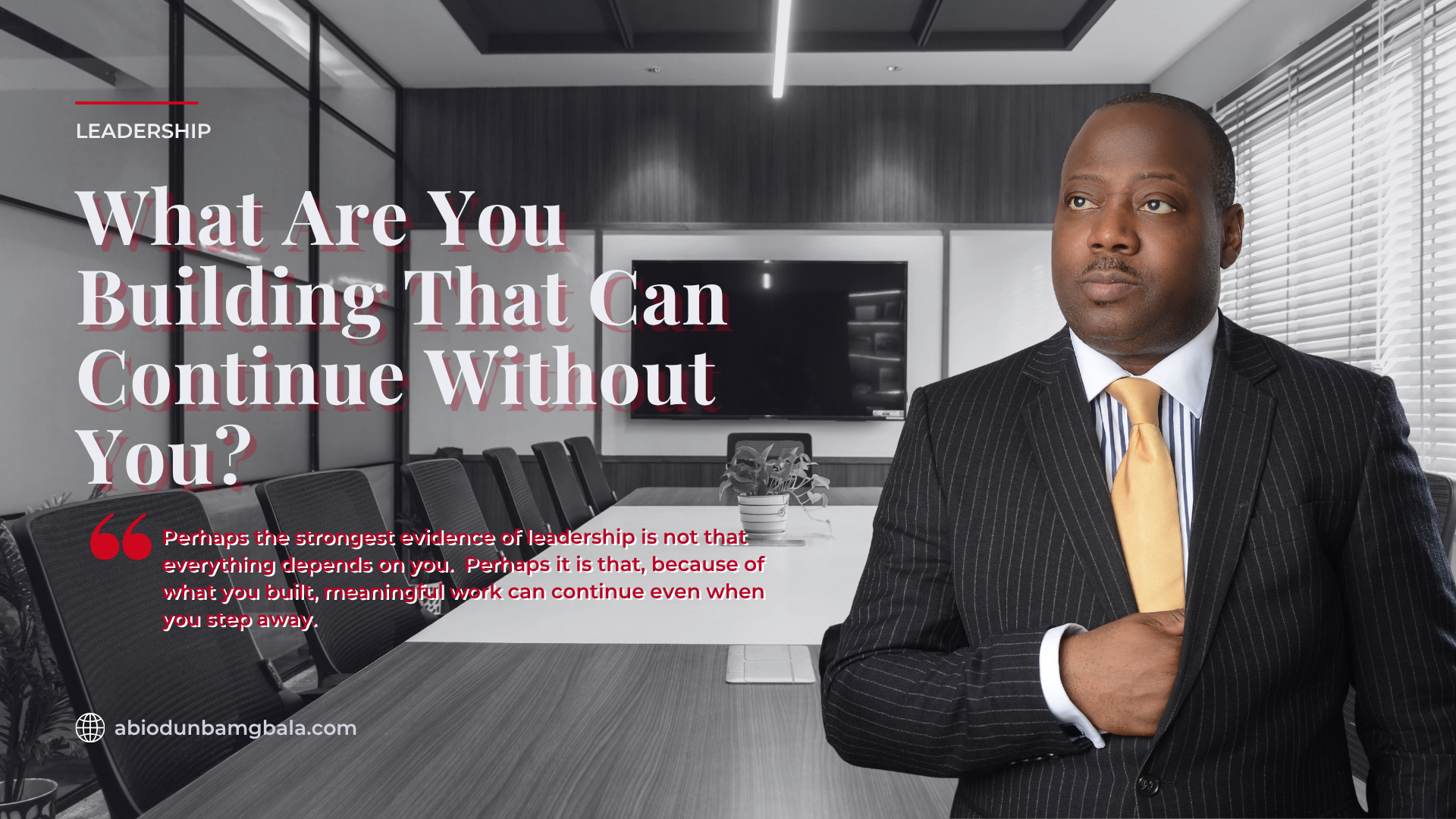
Perhaps the strongest evidence of leadership is not that everything depends on you.
Perhaps it is that, because of what you built, meaningful work can continue even when you step away.