When people hear that I am pursuing a Doctor of Business Administration, one of the first assumptions they make is that it is simply another academic qualification. While there is certainly a rigorous academic component to the journey, what has surprised me most is how much it has challenged the way I think about leadership.
The deeper I progress through the programme, the more I realise that leadership is not simply about experience, authority, or position. It is about learning continuously, questioning assumptions, and developing the discipline to think beyond immediate results.
One lesson that has become increasingly clear to me is that leadership and learning are inseparable. Many leaders reach a point where they begin to rely heavily on what has worked in the past. Experience is valuable, but experience alone can become limiting if it is not accompanied by continuous growth. The business environment is changing rapidly. Markets evolve. Technology advances. Customer expectations shift. Leaders who stop learning often find themselves leading with yesterday's answers to today's challenges.
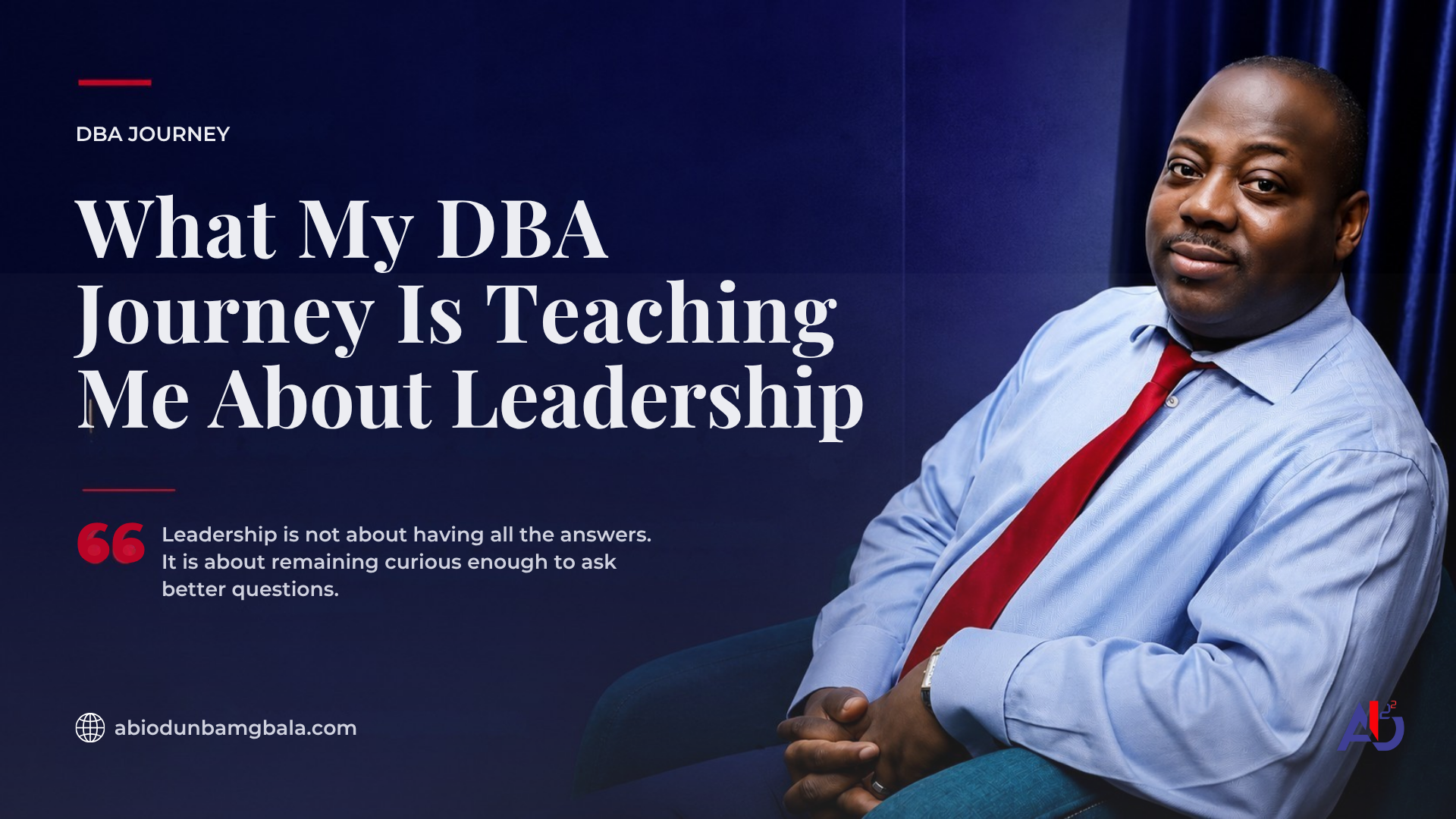
The DBA journey has reinforced the importance of intellectual humility. The more I learn, the more I recognise how much there is still to understand. Leadership is not about having all the answers. It is about remaining curious enough to ask better questions.
Another lesson I continue to reflect on is the difference between managing operations and leading transformation. Many organisations are effective at maintaining what already exists. Far fewer are prepared to build what does not yet exist. Leadership requires the ability to look beyond current realities and make decisions that prepare people and organisations for the future.
This has particular relevance for entrepreneurs and business owners. In many growing businesses, founders become deeply involved in daily activities. While operational involvement is necessary, long-term growth requires leaders to create systems, develop people, and build structures that can function beyond their direct supervision. A leader's value should not be measured solely by what they personally accomplish, but by what they enable others to achieve.
The DBA has also strengthened my appreciation for evidence-based decision making. In business, it is easy to rely on assumptions, opinions, or instinct alone. Experience certainly has its place, but effective leadership often requires balancing intuition with facts. The ability to analyse information critically and make informed decisions becomes increasingly important as organisations grow in complexity.
Perhaps the most important lesson of all is that leadership is ultimately a responsibility before it becomes a privilege. Every decision a leader makes affects employees, customers, stakeholders, families, and communities. Leadership carries influence, and influence carries accountability.
This perspective has caused me to think more intentionally about legacy. Success is important, but success alone is not enough. The more meaningful question is whether the organisations, people, and systems we build will continue creating value long after we are no longer directly involved.
My DBA journey is still ongoing, but it has already reinforced a belief I have held for many years: the best leaders never stop being students.
Titles may create authority. Experience may create confidence. Achievement may create recognition. But continuous learning is what sustains growth.
The moment a leader believes there is nothing left to learn is often the moment growth begins to slow.
For me, this journey is not simply about earning a doctorate. It is about becoming a better thinker, a better decision maker, and ultimately, a better leader.