When you start a business, being involved in everything often feels necessary.
You find the customers, approve payments, solve problems and make the important decisions. Your commitment keeps the business moving.
But as the business grows, something can change.
The very involvement that helped you build it can begin to hold it back.
The business may be generating revenue, employing people and attracting customers, yet almost nothing happens without you.
That is a form of success worth examining.
When Everything Waits for You
A customer needs an answer, but the team must ask you first.
An invoice needs approval, but you are in a meeting.
An employee encounters a problem, but nobody feels authorised to resolve it.
Individually, these may look like small delays. Together, they create an organisation that moves only as quickly as one person can respond.
The hidden cost is not simply your time. It is the capacity of the entire business.
When every decision comes back to you, your availability becomes the company's operating limit.
The Business Becomes More Expensive to Run
Founder dependency can affect profitability in ways that are not immediately obvious.
Employees spend time waiting for instructions. Customers experience delays. Opportunities are missed because nobody can act quickly enough.
You may eventually hire more people, but additional employees do not necessarily create additional capacity if every new person also needs your approval.
The company grows in size without becoming stronger in how it operates.
That is an expensive way to grow.
Your People Stop Developing
There is another cost that deserves attention.
When a founder makes every decision, employees have fewer opportunities to develop judgement.
They may become excellent at following instructions but uncertain when faced with something unfamiliar.
Over time, the founder becomes frustrated that nobody takes ownership, while the team has learned that taking initiative is not really expected.
Developing capable people requires more than assigning tasks.
It means giving them clear responsibilities, appropriate authority, useful information and room to make decisions.
It also means accepting that someone else may approach a problem differently and still achieve a good result.
You Lose the Space to Think
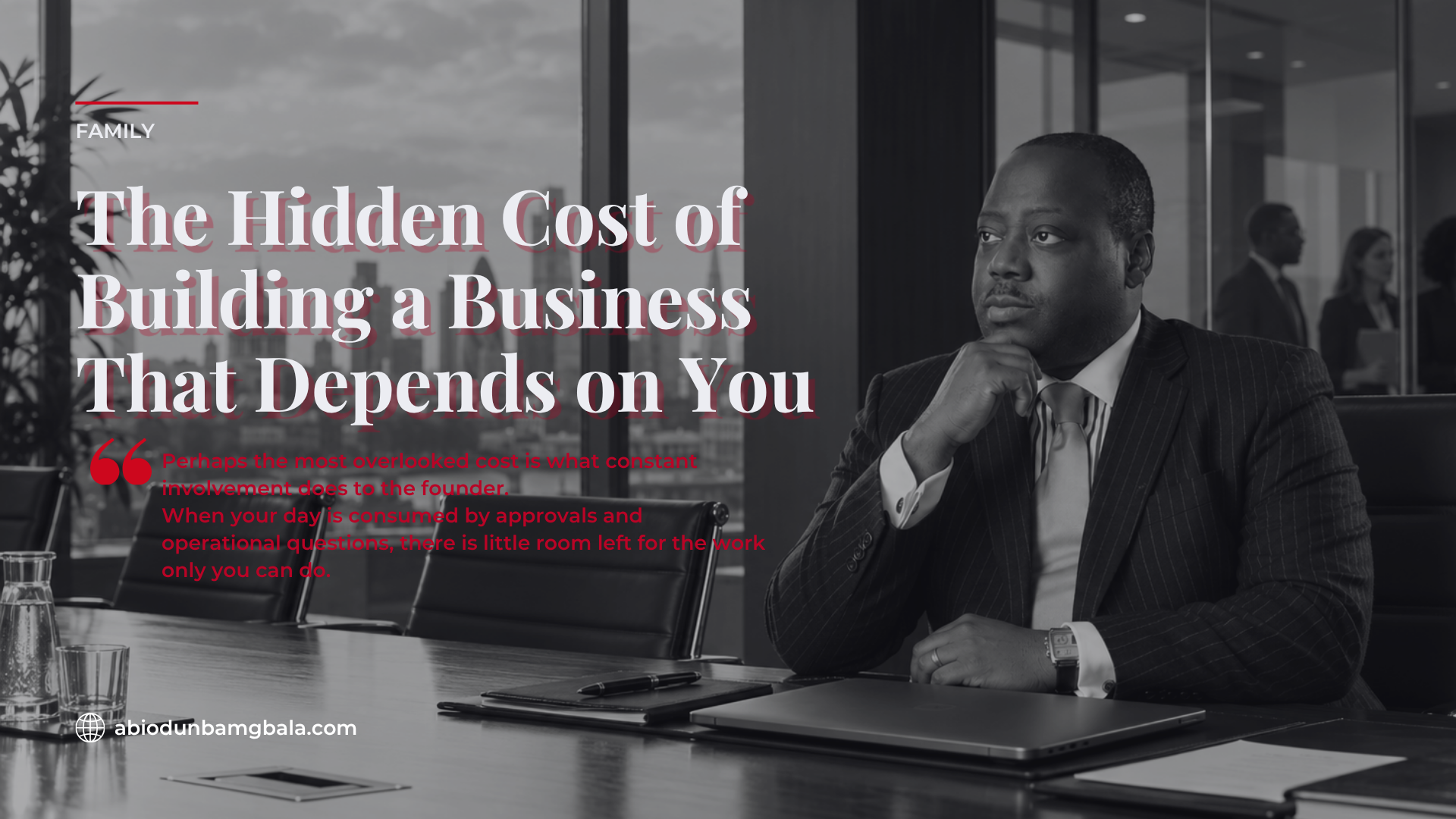
Perhaps the most overlooked cost is what constant involvement does to the founder.
When your day is consumed by approvals and operational questions, there is little room left for the work only you can do.
Thinking about the next market.
Developing senior leaders.
Understanding emerging risks.
Building relationships.
Considering the long-term direction of the company.
You may finish every day exhausted and still feel that the most important work has not been done.
Being needed everywhere can feel like evidence of leadership. Sometimes, it is evidence that the business needs a different structure.
Building a Business That Can Operate Without Constant Intervention
The solution is not to withdraw suddenly or delegate everything.
It is to become more deliberate about how the organisation works.
Start by identifying the decisions that repeatedly return to you. Which genuinely require your judgement, and which could be made by someone else with clearer guidance?
Document important processes. Give people defined authority. Establish reliable reporting so you can understand performance without personally supervising every activity.
Most importantly, invest in developing people who can carry responsibility.
Your role should gradually shift from solving every problem to building a company that can solve problems well.
That does not make you less valuable.
It allows your contribution to become more strategic.
Final Thought
A business that depends entirely on its founder can look successful for a long time.
But its weakness often becomes visible when the founder needs to step away, pursue another opportunity or simply take a break.
The question is not whether your business still needs you. Your leadership will continue to matter.
The question is whether it needs you for the right reasons.
Are you building a company that benefits from your leadership, or one that cannot function without your constant involvement?
The difference may determine how far the business can grow.