There is a question many business owners ask when growth slows:
“How do I get more customers?”
It is a reasonable question. But sometimes it is the wrong one.
Not every struggling business needs more customers. Some need better decisions.
More customers will not fix poor pricing. More sales will not fix weak financial controls. More employees will not fix poor management. More marketing will not fix a product customers do not value.
And more revenue can make things worse when the underlying structure is weak.
Growth can magnify both strengths and weaknesses.
More Sales Can Hide a Problem
Imagine a business generating £500,000 in annual revenue and aiming for £1 million.
The obvious response is to increase advertising, hire more salespeople and pursue more customers.
But what if the business is barely profitable?
What if some customers consume more resources than they generate? What if pricing has not been reviewed for years? What if the owner does not know which products actually produce the strongest margins?
Doubling revenue could simply double the complexity.
The business may become busier without becoming better.
Revenue is not the same as progress.
The Decisions You Avoid Become Part of Your Strategy
Strategy is not only about what you choose to do.
It is also about what you choose not to do.
Which customer should you stop serving?
Which product should you discontinue?
Which expense should you remove?
What should you automate or delegate?
Which opportunity looks attractive but would distract the business from its priorities?
These decisions are uncomfortable because they require more than ambition.
They require judgement.
Sometimes the next stage of growth begins with subtraction.
Are You Building a Business or Just Creating More Work?
If your business grows, does your life actually improve?
More customers can mean more messages. More employees can mean more management. More transactions can mean more administration.
If everything still depends on the owner, growth can become a burden rather than a breakthrough.
Eventually, the question has to change from:
“How can I do more?”
to:
“How can the business operate better without everything depending on me?”
That requires systems, delegation, processes and people who can make decisions without waiting for the founder.
Sometimes the Problem Is Lack of Focus
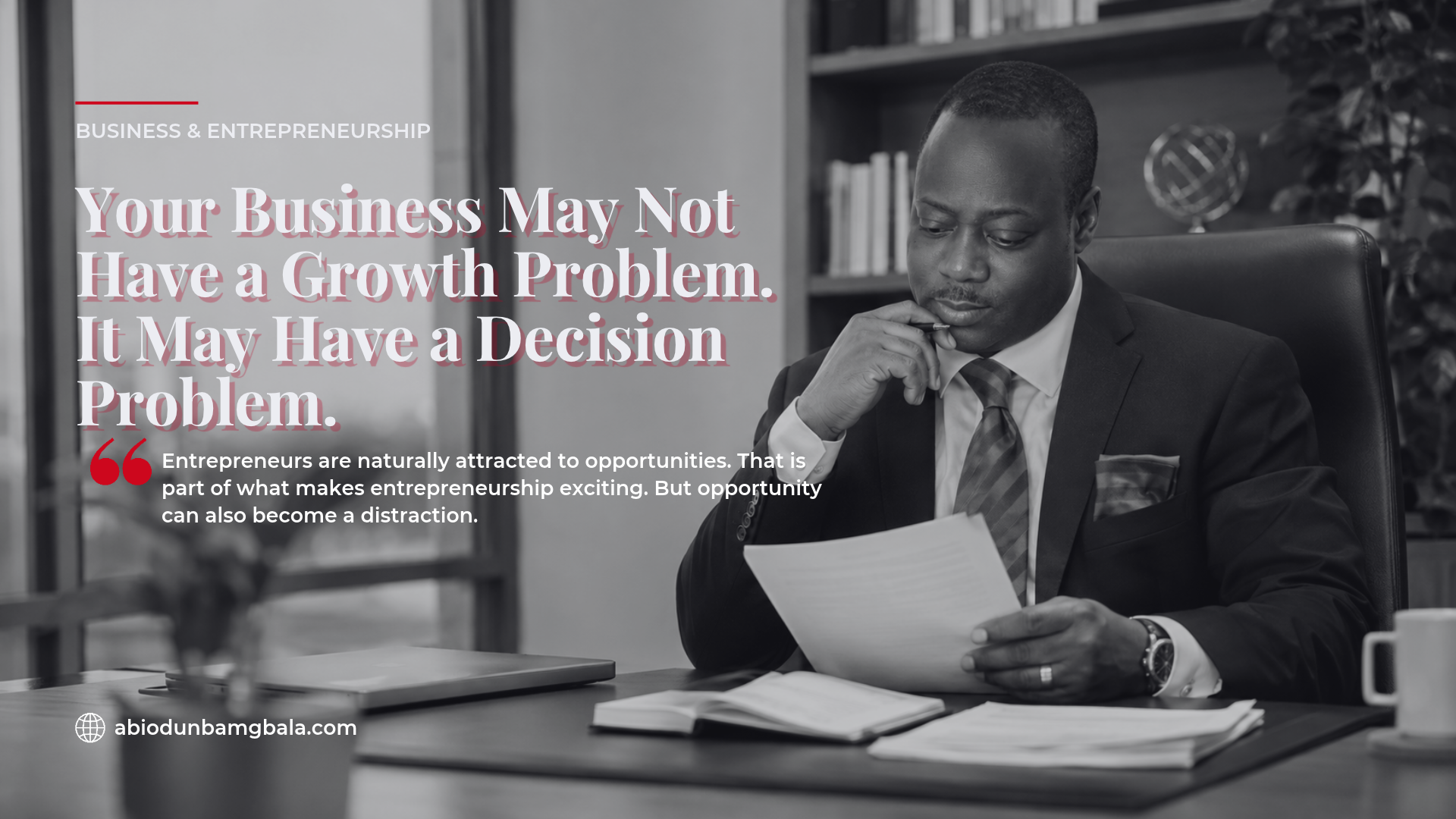
Entrepreneurs naturally pursue opportunities.
But opportunity can become distraction.
A business starts with one successful product. Then another opportunity appears. Then another.
Soon, it may be serving too many customer types, selling too many products and pursuing too many directions.
There is always activity, but not necessarily progress.
With limited resources, businesses must be deliberate about where they place their attention.
Focus is not the absence of opportunity. It is the discipline to choose which opportunities deserve your attention.
Better Questions Produce Better Businesses
Instead of always asking:
“How do I grow?”
ask better questions:
Why aren't we more profitable?
Which customers create the most value?
Where are we wasting money?
What part of the business depends too heavily on me?
What are we doing simply because we have always done it?
What should we stop?
What would break if revenue increased by 50%?
What would happen if revenue fell by 30%?
Which decision have I been postponing because it is uncomfortable?
These questions may not create immediate excitement.
But they can create something more valuable:
clarity.
Growth Requires Capacity
A business should not only prepare for more revenue.
It should prepare for what more revenue brings.
Can your systems handle it?
Can your team handle it?
Can your cash flow handle it?
Can your management structure handle it?
Can you handle it?
Sustainable growth is not simply about acquiring more customers. It is about increasing the organisation's capacity to serve them well.
Sometimes the most important investment is not another advertising campaign.
It may be a better accounting system, a stronger manager, a clearer process, better financial information, training, technology or simply the discipline to stop doing what no longer works.
The Uncomfortable Business Question
If your business is not growing as quickly as you want, do not automatically assume you need more marketing.
Look at the decisions.
Look at the numbers.
Look at the customers.
Look at the team.
Look at the systems.
And look honestly at your own leadership.
Perhaps you really do need more customers.
But perhaps you need something else.
Perhaps your business does not need more activity. Perhaps it needs better decisions.
Sometimes the decision that changes a business is not the one that creates something new.
It is the one that gives you the courage to stop doing what is no longer working.
What is one decision you know your business needs to make but have been postponing?