Sometimes, the hardest part is not getting the idea.
It is knowing what to do with it.
You have an idea for a business. A new service. A book. An investment. A career move. Perhaps something has been on your heart for months, and you keep asking yourself:
“Is this really from God, and what should I do next?”
As Christians, we should not assume that every good idea is automatically a God-given assignment. At the same time, we should not dismiss an idea simply because it looks difficult.
The next step is discernment.
Start With Prayer
Write the Idea Down
Test Before You Commit Everything
Take the First Step
Be Prepared for the Process
Check Your Motive
Steward the Idea
You Do Not Need to Know Everything
Before you start spending money, announcing the idea or building a business around it, take it to God.
Proverbs 3:5–6 reminds us to trust in the Lord and acknowledge Him in our ways.
Prayer is not a replacement for planning. It is where our planning begins.
Ask God for clarity.
Ask about the motive behind the idea.
Ask whether the opportunity aligns with the values and responsibilities He has already placed in your life.
Sometimes we are asking God to bless a decision we have already made instead of asking Him to direct the decision.
There is a difference.
An idea in your head can feel much bigger than it actually is.
Write it down.
What exactly are you trying to build?
Who does it serve?
What problem does it solve?
What resources would it require?
What would success look like?
What would the first practical step be?
Habakkuk 2:2 says, “Write the vision, and make it plain.”
Clarity gives you something you can examine.
You cannot properly test what you have never clearly defined.
Faith does not mean abandoning wisdom.
If you believe you have received a business idea, investigate it.
Speak to people who understand the market. Study the problem you are trying to solve. Look at the numbers. Understand the risks. Start small where appropriate.
A God-given idea still requires good stewardship.
Nehemiah is a useful example. Before rebuilding the walls of Jerusalem, he assessed the situation and understood what needed to be done.
Faith and preparation worked together.
One of the easiest ways to kill a good idea is to keep waiting for perfect conditions.
You may never have all the money.
You may never have complete certainty.
You may never feel completely ready.
But there is a difference between waiting for God's direction and using uncertainty as an excuse for inaction.
Once you have gained reasonable clarity, take the next responsible step.
It may be making the first call.
Registering the business.
Testing the product.
Learning the skill.
Speaking to a potential customer.
Creating the first version.
The first step does not have to be big.
It simply has to move you forward.
We often want the idea and the result at the same time.
But between the two is a process.
Joseph received dreams about his future, but his journey did not immediately resemble the outcome he had seen.
There were seasons of difficulty, preparation and waiting.
That does not mean every difficult season is automatically confirmation that an idea is from God.
It means that purpose often requires patience.
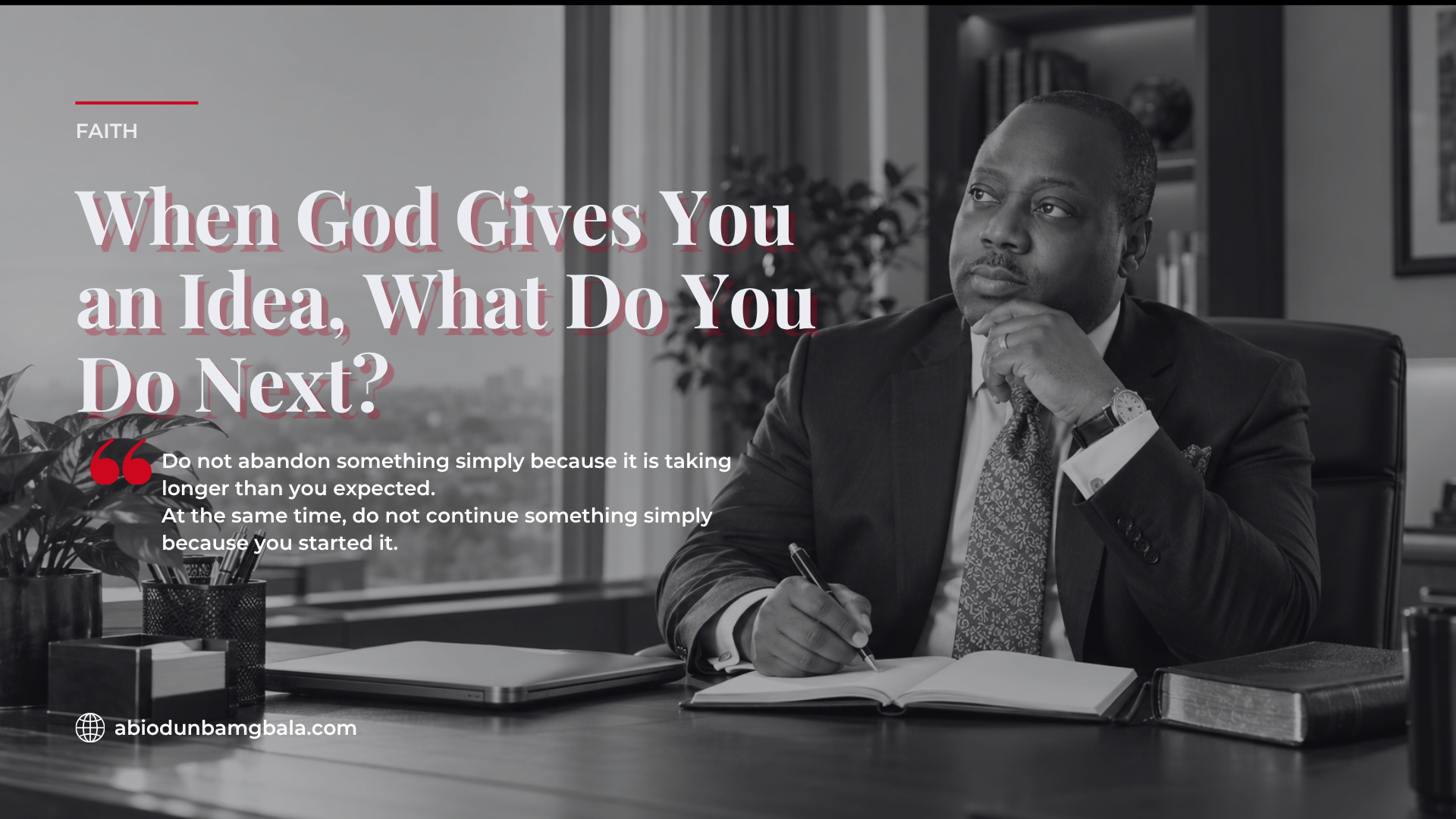
Do not abandon something simply because it is taking longer than you expected.
At the same time, do not continue something simply because you started it.
Keep listening.
Keep learning.
Keep evaluating.
This is one of the most important questions.
Why do I want this?
Is it because you genuinely want to create value?
Is it because you want to serve people?
Is it because you believe you have been entrusted with something?
Or is it primarily about recognition, comparison, money or proving something to someone?
God is interested not only in what we build, but in why we build it.
Colossians 3:23 reminds us to work wholeheartedly, as working for the Lord.
Your motive matters.
If you believe God has entrusted an idea to you, treat it as a responsibility rather than merely an opportunity.
Learn.
Prepare.
Build wisely.
Manage the resources available to you.
Develop the people around you.
And remain accountable.
The Parable of the Talents in Matthew 25 reminds us of the responsibility attached to what has been entrusted to us.
The question is not simply, “What did I receive?”
It is also, “What did I do with what I received?”
Sometimes people delay starting because they think they need the entire roadmap.
You may not.
You may only need enough clarity for the next step.
Faith often requires movement before you can see the whole journey.
So if you believe God has given you an idea, do not rush into it blindly.
But do not bury it in fear either.
Pray about it. Write it down. Test it. Seek wise counsel. Take the next step. Stay teachable.
And as the idea develops, remain willing to let God refine it.
Because sometimes the idea God gives you at the beginning is not the finished version of what He wants you to build.
The idea may be the seed. Your responsibility is to steward it well.