What if being busy is creating the illusion of progress?
In many businesses, there is always something happening.
The phones are ringing.
The team is working.
Customers are being served.
Meetings are being held.
Problems are being solved.
From the outside, it can look like growth.
But activity is not always the same as strength.
A business can become busier without becoming more profitable, more organised, more resilient or more valuable.
That is the distinction many business owners miss.
Busyness can hide weakness
When a company is growing, pressure usually increases before structure catches up.
More customers create more enquiries.
More staff create more management responsibility.
More sales create more transactions to monitor.
More opportunities create more decisions to make.
If the underlying systems are weak, growth can simply multiply the weaknesses that were already there.
The business becomes louder, but not necessarily stronger.
A team may be working longer hours while mistakes are increasing.
Revenue may be rising while cash flow remains under pressure.
More customers may be coming in while existing customers are quietly leaving.
The owner may appear successful while becoming increasingly exhausted.
At that point, the question should not be, “How much are we doing?”
The better question is, “What is all this activity actually producing?”
Strong businesses improve beneath the surface
Real business progress is often less visible than busyness.
It looks like clearer processes.
It looks like stronger margins.
It looks like better customer retention.
It looks like employees who can make good decisions without waiting for the founder.
It looks like accurate financial information.
It looks like fewer repeated mistakes.
It looks like a business that can handle increased demand without becoming chaotic.
These things may not attract the same attention as a new office, a larger team or a sudden increase in sales.
But they are what make growth sustainable.
Revenue alone does not tell the full story
A business can increase revenue and still become weaker.
If costs are rising faster than income, the business may be working harder for less.
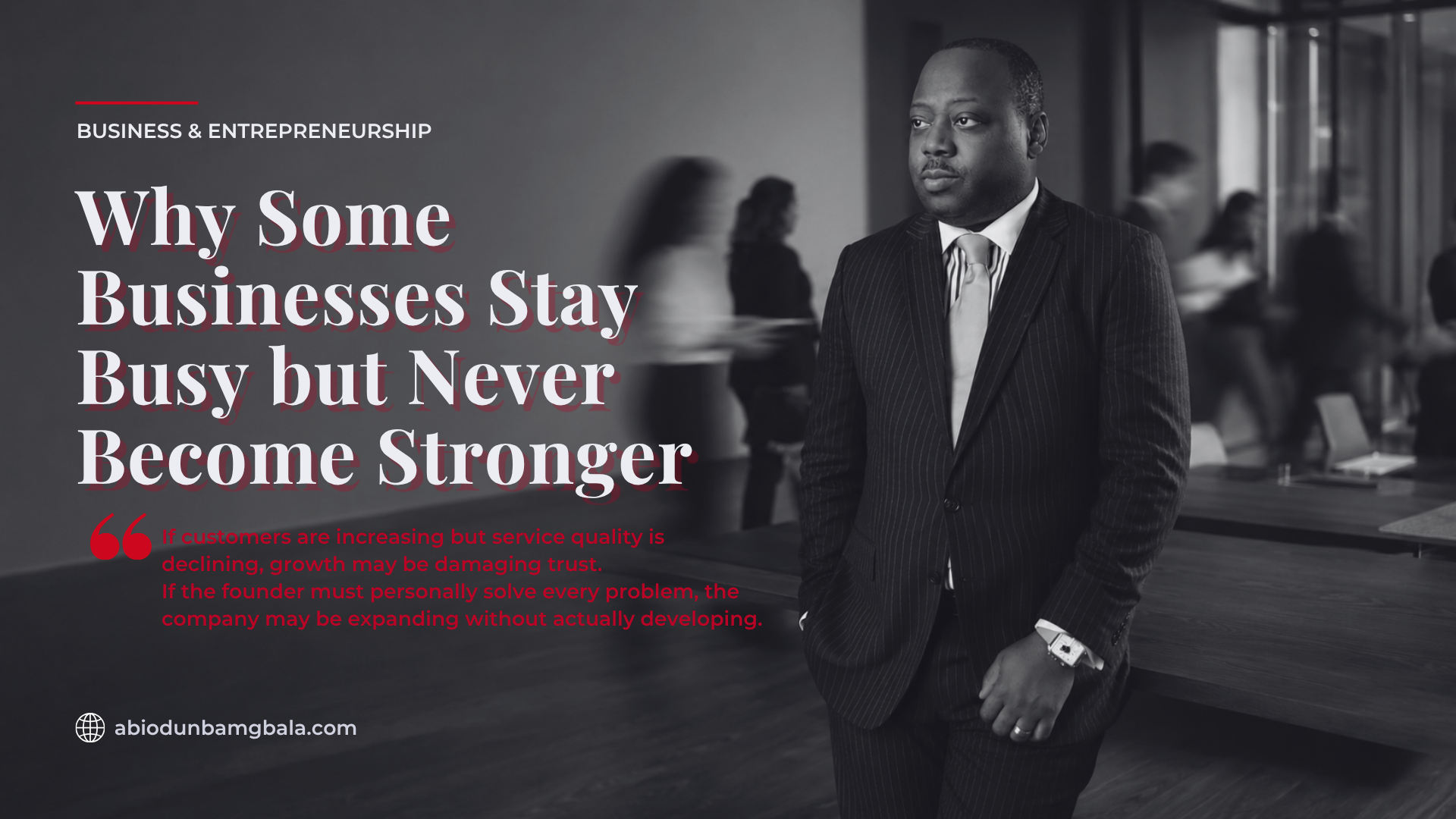
If customers are increasing but service quality is declining, growth may be damaging trust.
If the founder must personally solve every problem, the company may be expanding without actually developing.
This is why business owners must look beyond headline numbers.
Is profitability improving?
Is cash flow healthier?
Are customers staying?
Is the team becoming more capable?
Are systems reducing unnecessary work?
Is the business becoming easier or harder to manage as it grows?
Those questions reveal more than activity ever will.
Growth should create capacity
The goal of growth should not be to create permanent pressure.
It should gradually create more capacity.
Better systems should reduce confusion.
Better people should distribute responsibility.
Better information should improve decisions.
Better processes should make performance more consistent.
If every new customer creates another crisis, something underneath the business needs attention.
Sometimes the next stage of growth does not require more marketing, more staff or more sales.
Sometimes it requires strengthening what already exists.
So, is your business genuinely becoming stronger?
Or has everyone simply become busier?
Perhaps one of the most important disciplines in business is learning to separate movement from progress.
Because a strong business is not defined by how much activity it can generate.
It is defined by how much value, stability and capacity that activity creates.